Advantages of ZEISS Laser

1. Laser Performance Cannot Be Judged by Speed Alone
When discussing laser devices used in vision correction surgery, many people first think of the repetition rate displayed in MHz or kHz. It is easy to assume that the higher the number, the faster the surgery will be completed and the better the results will be. However, in reality, the quality of surgery cannot be determined solely by speed figures.
What truly matters is not just the number of laser pulses, but the entire process before and after the beam is fired—preparation, stable energy delivery, and precise targeting. All of these steps must work in harmony to achieve satisfactory surgical outcomes.
2. Common Ground Between Shooting and Laser Procedures
To better understand this principle, let’s take shooting as an example. Suppose there is a bullet that travels at 600 meters per second. Does that mean it will reach a target 600 meters away in exactly one second? Not necessarily. In reality, there are multiple steps: loading the bullet, aiming, firing, and ensuring it reaches the target accurately. External factors such as wind speed, distance, and angle also come into play.
The same applies to lasers. It is not simply about firing a beam; the laser must charge energy before firing, align the irradiation point with precision, and adjust to the exact corneal depth. Therefore, determining surgical time and quality based only on speed metrics is inaccurate.
 |
| ▲ Comparison Between Shooting and the Laser Vision Correction Process |
3. Precision Control Technology Matters More Than Speed
For example, even if a laser operates at a repetition rate of 5 MHz, its speed is meaningless without accurate targeting, correction of fine errors along the X, Y, and Z axes, and consistent energy delivery.
What plays a crucial role here is the scanning technology that directs the laser. The process of generating the laser involves repeated reflections through internal mirrors, and the accuracy and response speed of these mirrors directly affect the quality of the laser.
Such precision control technology has long been safeguarded as a state secret due to its importance and is still utilized today in advanced industrial fields.

4. ZEISS Ultra-Precision Laser Technology
With over 175 years of expertise in optics, ZEISS has built unparalleled technological capabilities in fields such as microscopes, cameras, and semiconductor manufacturing equipment. This same ultra-precision technology is applied to ZEISS vision correction laser devices.
Through a mirror control system precise enough to be used in semiconductor production, ZEISS has dramatically shortened laser firing intervals and reduced corneal exposure time. In practice, the VisuMax 500 completes laser irradiation in about 25 seconds, while the VisuMax 800 finishes in under 8 seconds. This is among the fastest speeds in lenticule extraction vision correction surgery, significantly reducing surgical burden on patients.
5. The Difference Made by Fast and Smooth Cutting
Another advantage of ZEISS lasers is not only speed but also the smoothness of the cutting process. Because the laser’s interval and position are precisely controlled across the X, Y, and Z axes, a uniform and smooth lenticule is created within the cornea.
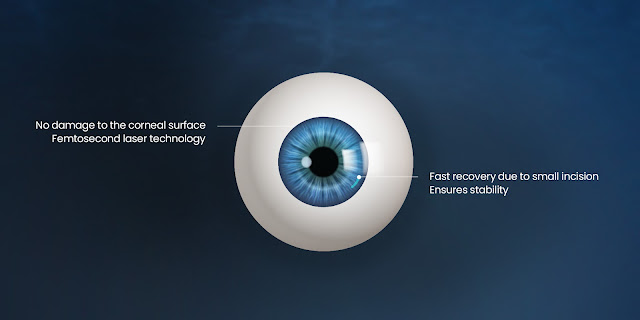
When the cutting surface is even, the extraction process becomes gentler, resulting in less corneal damage and faster recovery with greater visual stability. This allows patients to achieve clearer, more comfortable vision immediately after surgery, while also reducing the risk of inflammation or other complications.

6. Choosing for Long-Lasting Quality of Vision
Ultimately, what matters most in vision correction surgery is not momentary speed, but the combination of multiple factors: efficiency in the preparation phase before laser firing, precision in micro-targeting and scanning, and technologies that minimize stress on the cornea.
ZEISS laser technology integrates these elements in balance, enabling the creation of lenticules that are both fast and smooth, while reducing corneal damage. This helps patients maintain stable vision over the long term. The goal is not just to achieve temporary improvement, but to ensure sustained, high-quality vision for years to come.
Therefore, when considering vision correction, it is wise not to focus solely on repetition rate figures, but also to carefully examine how the device delivers its laser energy and how well its technology has been clinically proven.

Comments
Post a Comment