1. Over 30 Years of Vision Correction – Lens Implantation Surgery
Among vision correction procedures, lens implantation has a history spanning more than 30 years. Many people believe LASIK or LASEK are the longest-standing techniques, but in fact, lens implantation was introduced into clinical practice even earlier. Over the decades, it has been performed consistently, providing countless patients with stable and reliable vision correction results.
What is particularly noteworthy is that even as vision correction techniques diversify and demand for LASIK and LASEK gradually decreases, lens implantation continues to maintain strong popularity. This is not simply because of its long history, but because its unique advantages make it a compelling choice for many patients.
 |
| ▲ Lens Implantation Surgery that Preserves the Cornea |
2. A Safe Method that Preserves the Cornea
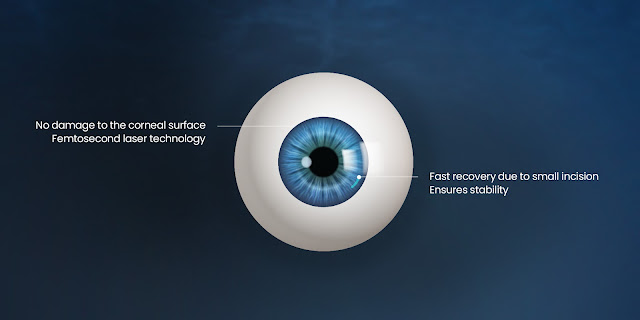
One of the key advantages of lens implantation surgery is that it does not damage the cornea. Laser vision correction procedures such as LASIK or LASEK require removing a certain thickness of corneal tissue, which makes them unsuitable for patients with thin corneas or very high myopia. In fact, excessive corneal removal can increase the risk of complications such as keratoconus.
In contrast, lens implantation does not involve cutting the cornea. Instead, a specially designed lens is implanted inside the eye. This allows patients with thin corneas or high myopia to undergo surgery safely, while preserving the natural corneal structure. For this reason, lens implantation is often referred to as a “cornea-preserving vision correction procedure,” offering advantages in terms of long-term safety and stability.
 |
| ▲ Classification based on the iris: anterior chamber lens (A) and posterior chamber lens (B) |
3. Reversibility – The Option to Return if Needed
Another major advantage of lens implantation surgery is its reversibility. If vision changes over time, or if eye conditions such as cataracts or glaucoma develop, the implanted lens can be removed, allowing the eye to return to its pre-surgery state. While lens removal is rarely needed in practice, the very possibility of doing so provides patients with peace of mind.
This is one of the biggest differences compared to laser procedures that remove corneal tissue. In LASIK or LASEK, once the cornea has been reshaped, it cannot be restored to its original form. In contrast, lens implantation preserves the eye’s natural structure, enabling flexible adjustments in the future if necessary. For this reason, it is particularly suitable for patients who wish to prioritize long-term eye health and safety.
 |
| ▲ Anterior chamber lens fixed to the iris |
4. Differences in Lens Types and Implantation Positions
Lens implantation can be divided into anterior chamber lenses and posterior chamber lenses depending on where the lens is placed. An anterior chamber lens is fixed to the iris, which prevents rotation and keeps it unaffected by the position of the natural lens. In contrast, a posterior chamber lens does not invade the space in front of the iris, thereby lowering the risk of corneal endothelial cell damage.
Both methods have distinct advantages, and neither can be said to be absolutely superior. The best option depends on a comprehensive evaluation of the patient’s eye structure, corneal thickness, and the distance between the iris and the natural lens. For this reason, precise pre-operative examinations are essential to determine which lens will provide the most stable and safe vision correction.
5. Precision Sizing to the Nearest 0.01 mm
In lens implantation, size is just as important as the type of lens. The spacing between the cornea, iris, and crystalline lens inside the eye is extremely fine and complex. If the lens is too large, it may touch the cornea, endothelium, iris, or crystalline lens, leading to complications. If the lens is too small, it may fail to stay properly in place, reducing the effectiveness of vision correction.
To ensure accuracy, manufacturers produce lenses in hundreds of different sizes measured in 0.01 mm increments. For safety, the U.S. FDA also provides specific standards: anterior chamber lenses must be at least 3.2 mm, and posterior chamber lenses at least 3.0 mm. Each patient’s unique eye measurements are carefully assessed against these guidelines to select the safest and most effective lens size.
 |
| ▲ Document related to posterior chamber lens depth regulations |
6. The Importance of Precise Examinations and Experienced Surgeons
Determining the type and size of the lens is an extremely delicate process. It requires high-resolution ocular imaging equipment and precise measurement techniques. Just as important is the experience and expertise of the surgeon performing the procedure. Because even a 0.01 mm error cannot be tolerated, it is essential to choose a clinic that conducts examinations and surgeries in a systematic, detail-oriented manner to ensure both safety and patient satisfaction.
7. A Choice That Will Continue Into the Future
Lens implantation will remain a widely chosen vision correction option thanks to its ability to preserve the cornea and be reversible if needed. For patients who are not suitable candidates for laser-based vision correction, it provides a safe and effective alternative. For those who value long-term eye health, it represents a particularly appealing solution.
When considering vision correction surgery, the most important step is to receive an accurate diagnosis of your eyes and identify the method most suitable for you. Lens implantation shows its true value when precise testing is combined with the hands of highly experienced surgeons. We hope this information helps guide you toward making the best decision for your vision correction journey.


Comments
Post a Comment