Jeong, a 27-year-old graduate student majoring in music, underwent SMILE Pro surgery for astigmatism two weeks ago and expressed great satisfaction, saying she had “regained clear vision for the first time in ten years.”
Because her daily routine involved long hours of composing and practicing while reading sheet music and digital screens, she began to experience visual fatigue and overlapping notes and letters. Examination revealed that her vision had deteriorated to the level of high astigmatism. After receiving a detailed consultation and preoperative tests, she underwent SMILE Pro and has since maintained stable, improved vision.
Astigmatism occurs when the cornea has an irregular curvature, preventing light from focusing evenly on the retina. As in Jeong’s case, leaving astigmatism untreated or improperly corrected can interfere with work performance and daily activities. Common symptoms include blurred or distorted vision, eye strain, and double vision, often appearing in combination.
According to the Korea Optometric Association, among 1,500 Korean adults aged 20 and older surveyed in 2023, 73.4% were using glasses or contact lenses to correct their vision—an increase of 17.5% from 55.9% in 2021. Despite widespread vision correction, many people overlook astigmatism, a common refractive error.
More than half of Korean adults (approximately 58%) have astigmatism. However, a global study found that 7 out of 10 contact lens wearers with astigmatism use non-toric lenses, suggesting limited awareness of proper astigmatism correction.
There are several methods to correct astigmatism, but among the most effective options for patients with high myopia and astigmatism are SMILE LASIK and SMILE Pro.
Earlier-generation procedures such as LASEK and LASIK can also correct astigmatism, but both involve removing or creating a corneal flap, which can make the eye more vulnerable to external trauma and slow recovery.
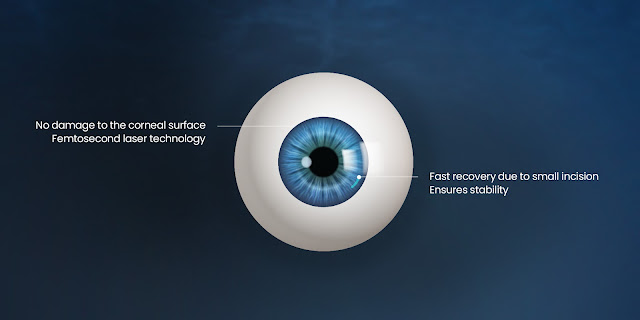
By contrast, SMILE LASIK (Small Incision Lenticule Extraction) corrects vision through a minimal 2 mm incision. Using the VisuMax 500 femtosecond laser system developed by Carl Zeiss, the procedure removes a small lenticule of corneal tissue corresponding to the refractive error, without cutting the corneal surface. Because the laser passes through the intact corneal surface, nerve damage is minimal, leading to faster recovery, minimal discomfort, and a lower risk of complications such as dry eye or myopic regression. The cornea also remains strong against external impact, allowing patients to resume light activities like walking or gentle exercise the next day.
SMILE Pro is an upgraded version of SMILE LASIK.
While both share the same surgical principle, the difference lies in the equipment used. SMILE Pro employs the VisuMax 800, which operates about three times faster than the VisuMax 500.
Whereas laser scanning for SMILE LASIK takes roughly 25 seconds, SMILE Pro completes it in under 8 seconds, reducing total procedure time by two-thirds and minimizing patient stress and the risk of suction loss.
The newly introduced CentraLign and OcuLign functions act as navigational guides to enhance precision.
CentraLign automatically tracks and corrects the visual axis in real time, improving surgical accuracy, while Oculign adjusts the astigmatic axis based on diagnostic data, reducing axis deviation and providing sharper vision.
SMILE Pro enables personalized, center-aligned correction based on the visual axis and allows precise treatment even for patients with high myopia and high astigmatism.
Both SMILE LASIK and SMILE Pro are advanced procedures that require high surgical skill and concentration. Because the corneal lenticule must be delicately separated through a small incision, the surgeon’s expertise and experience play a crucial role. One useful credential to look for is “SMILE Doctor Certification,” issued by Carl Zeiss, which recognizes surgeons who meet high standards in surgical accuracy, skill, and experience.


Comments
Post a Comment