Common Misunderstandings and Correct Information Regarding Minus Vision

What Is “Minus Vision”?
Vision refers to the ability to observe and recognize the environment through the eyes, allowing us to clearly identify stationary or moving objects. It plays a crucial role in daily life and is typically expressed as a decimal value during vision tests.
Visual acuity is commonly represented by numbers such as 1.5, 1.0, or 0.1, which quantify how well a person can recognize objects.
-
1.0–1.5 visual acuity: Considered within the normal range, allowing clear recognition of objects at a typical viewing distance
-
0.1 visual acuity: Indicates significantly reduced vision, making object recognition difficult
Misconceptions and Facts About “Minus Vision”
The term “minus vision” is commonly used in everyday language, but medically, there is no such concept as negative vision. Visual acuity is evaluated based on a scale where 1.0 is the standard reference point; the closer the value is to zero, the more severe the visual impairment.
When vision is so poor that it cannot be measured using a standard eye chart, it may be perceived in everyday terms as being close to blindness. However, medical blindness is determined by considering both corrected visual acuity and visual field range. Therefore, the expression “minus vision” has no direct relationship to actual visual acuity measurements.
“Minus” Refers to Myopia, Not Vision
The minus (–) sign is often misunderstood as a vision score, but it actually refers to the refractive power of a lens. Myopia (nearsightedness) occurs when the eye’s refractive power is too strong, causing light to focus in front of the retina rather than directly on it. As a result, distant objects appear blurred.
To correct this, concave (minus) lenses are used, which is why myopia prescriptions are marked with a (–) sign. In contrast, hyperopia (farsightedness) occurs when refractive power is insufficient, making it difficult to see distant objects clearly. This condition requires convex (plus) lenses, which are indicated with a (+) sign.
Thus, a minus (–) designation indicates myopia, while a plus (+) designation indicates hyperopia. These markings are essential for selecting appropriate glasses or contact lenses and serve as a way to quantify refractive error rather than visual acuity.
What Is Myopia?
Myopia is a refractive error in which incoming light focuses in front of the retina instead of directly on it when the eye is in a relaxed state, resulting in blurred distance vision.
 |
| Myopia: Light focuses in front of the retina. |
 |
| Normal vision (emmetropia): Images are focused directly on the retina. |
 |
| Farsightedness (hyperopia): Images are focused behind the retina, making near objects appear blurry. |
This refractive error occurs when light passing through the eye’s lens does not focus properly on the retina but instead converges in front of it. As a result, distant objects cannot be seen clearly.
Myopia requires regular eye examinations by an ophthalmologist to monitor visual status and determine appropriate management. Based on the results of routine eye exams, an eye care specialist may prescribe suitable glasses or contact lenses or recommend various methods to manage the progression of myopia. Using glasses or lenses with an incorrect prescription can worsen vision problems; therefore, receiving an accurate prescription and wearing corrective lenses consistently is essential.
Vision Correction Surgery for Myopia
Vision correction surgery uses precise laser technology to adjust the refractive power of the corneal stroma. Depending on the surgical technique, these procedures are generally classified into three types.

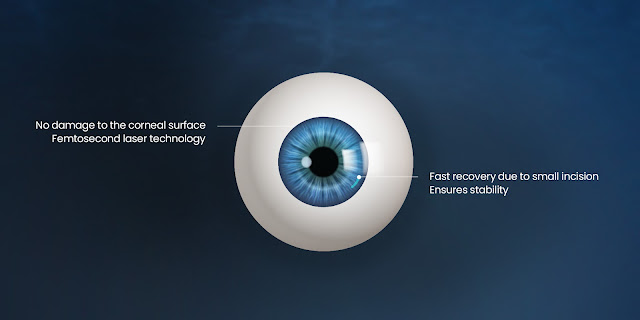
SMILE LASIK (SMILE): A procedure that corrects only the corneal stroma using a femtosecond laser. It allows for recovery within a day and has the advantage of a lower risk of side effects such as dry eye.

LASIK: This procedure involves creating a corneal flap and then using a laser on the underlying stroma to correct refractive errors. Recovery is fast, but it has drawbacks, such as increased susceptibility to external trauma and dry eye.

Choosing the most suitable surgical method depends on the degree of myopia and the individual’s eye condition. It is essential to consult with an ophthalmologist and undergo a thorough eye examination before deciding on the procedure that best fits your needs.
With advances in technology, many patients opt for surgery to improve vision, but collaboration with an eye care professional is crucial in every case. Careful consideration of your eye health and lifestyle is recommended when making a decision.

Comments
Post a Comment