Lens implantation surgery — size matters.

Lens implantation surgery is a vision correction procedure that improves refractive errors by inserting a special lens inside the eye. It is often recommended for patients with thin corneas or very high myopia, as it can be safely performed in such cases.
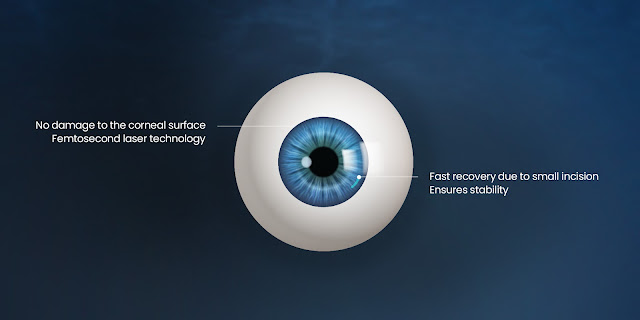
Since only a small incision is made in the corneal epithelium during the procedure, it involves minimal pain, and patients can usually return to daily activities—such as going বাইরে, wearing makeup, and showering—from the next day.
In addition, with advancements in technology, techniques such as iris-fixated lenses and designs that facilitate the natural flow of aqueous fluid inside the eye have been developed. As a result, both the safety of the procedure and surgical outcomes have steadily improved.
Types of lens implantation by insertion position
Lens implantation surgery can be divided into two types depending on where the lens is placed: anterior chamber lens implantation and posterior chamber lens implantation.

Anterior Chamber Lens Implantation
This method involves inserting the lens in front of the iris and fixing it by attaching it to the iris. Representative lenses include Artiflex/Toric and Artisan/Toric/Aphakic lenses.
Artiflex lenses do not come into direct contact with the natural lens, which helps prevent cataract formation. Artisan lenses have a long history and can be used across a wide range of vision corrections. Anterior chamber lens implantation may also help reduce the risk of glaucoma and cataracts.
Posterior Chamber Lens Implantation
This method involves placing the lens behind the iris, without the need for an iris incision. The lens features a central hole that allows the natural flow of aqueous fluid inside the eye.
It offers advantages such as minimal pain, fast recovery, and relatively strong resistance to external impact. Representative lenses include EVO+ Aqua ICL/Toric and Echo/Toric lenses. In particular, EVO Aqua ICL allows for a quicker procedure without the need for an iris incision.
Additionally, there are almost no limitations in the range of vision correction, allowing for more precise outcomes.
Lens Implantation — Why Size Matters

Since the size of the internal eye space varies from person to person, a thorough examination is essential to determine whether there is sufficient space for lens implantation. After the examination, selecting the correct lens size tailored to the individual’s eye structure is crucial to reducing the risk of side effects, such as astigmatism, after surgery.
At Bright Eye Clinic Gangnam, we perform a precise analysis of the internal eye space using triple CT imaging, enabling customized lens selection down to 0.01 mm. In addition, surgeries are carried out in accordance with FDA safety standards for anterior chamber depth, and are performed directly by experienced reference surgeons with over 10 years of experience and more than 10,000 cases.

Comments
Post a Comment