Factors to Consider Before SMILE Surgery

SMILE Pro is a next-generation vision correction procedure based on the latest VISUMAX 800 platform developed by Zeiss. While retaining the proven advantages of conventional SMILE (Small Incision Lenticule Extraction) surgery, it incorporates several technological enhancements designed to improve precision, efficiency, and patient safety. Given that SMILE has been performed more than 8 million times worldwide and approximately 1.3 million times in Korea, its safety and effectiveness are well established. Building on the same validated principles, SMILE Pro enables even faster and more precise vision correction.
SMILE Pro is not simply a rebranded version of SMILE. It represents an upgraded procedure that includes advancements such as faster laser delivery, enhanced centration and eye-tracking capabilities, and cyclotorsion (astigmatic axis rotation) compensation. These features are designed to improve surgical accuracy and optimize outcomes. However, the availability of advanced technology alone does not guarantee the best results. Successful vision correction also depends on the surgeon’s expertise, as well as the clinic’s ability to perform comprehensive preoperative evaluations and effectively utilize diagnostic data to create a personalized treatment plan.
 |
| ▲ SMILE Surgery: Lenticule Extraction Procedure |
1. Surgeon Expertise and Experience
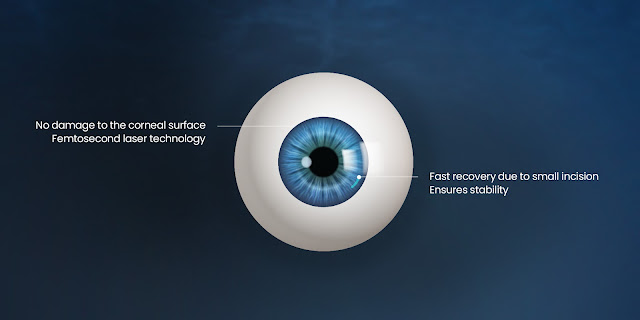
Both SMILE Pro and conventional SMILE correct vision through a minimally invasive approach involving a small corneal incision of approximately 2–4 mm. During the procedure, a thin disc-shaped piece of corneal tissue, known as a lenticule, is created and then removed through the incision to reshape the cornea and correct refractive errors.
While the femtosecond laser is responsible for creating the lenticule, the critical step of separating and extracting it is performed entirely by the surgeon. This stage requires exceptional precision and delicate handling to minimize corneal trauma, promote faster visual recovery, and achieve stable long-term outcomes.

2. Comprehensive Diagnostic Evaluation and Personalized Treatment Planning
Achieving optimal outcomes with SMILE Pro requires more than advanced diagnostic technology. In addition to detailed vision and corneal assessments, personalized surgical planning based on extensive clinical data is essential.
A key component of this process is the use of a nomogram—a data-driven analytical model that helps determine the ideal treatment parameters for each patient. Nomograms incorporate a wide range of individual factors, including corneal thickness, anterior and posterior corneal curvature, pupil size, astigmatic axis, and the degree of refractive error. Based on this information, the appropriate correction amount and laser treatment pattern can be customized to the patient's unique ocular characteristics.

Proven Technology with Enhanced Precision
Although SMILE Pro is a recently introduced procedure, its fundamental principles are the same as those of conventional SMILE surgery, which has already been performed millions of times worldwide and has a well-established track record of safety and effectiveness. Rather than being an entirely new surgical method, SMILE Pro is an evolution of a proven procedure, incorporating advanced technology and additional features to further improve precision and efficiency.


Comments
Post a Comment