SMILE LASIK vs. LASEK: Is the Recovery Period Really That Different?

Evidence from randomized controlled trials directly comparing recovery times for SMILE and LASEK remains limited. A Cochrane review of trials comparing the procedures found no trials that reported postoperative pain scores [1].
Visual
acuity at 12 months did not differ significantly between the procedures. When LASEK and LASIK were compared, the proportions of patients achieving uncorrected visual acuity (vision measured without glasses) of 20/20 or better were similar [1].
Questions
like this appear on Naver Knowledge iN:
“I’d like to know how much the recovery speed actually differs between SMILE LASIK and LASEK, and which procedure causes more pain. I spend a lot of time working on a computer, so I’d also appreciate an explanation of when I could return to work after surgery.”
How do the three procedures differ in the way they treat the cornea?
The three procedures
involve different layers of the cornea, the transparent membrane at the front
of the eye. The Korea Disease Control and Prevention Agency (KDCA) lists
laser-assisted in situ keratomileusis (LASIK), laser-assisted subepithelial
keratectomy (LASEK), and phakic intraocular lens implantation among the
surgical options for myopia [5].
LASIK: A flap is created in the cornea and lifted. The
underlying tissue is reshaped with a laser, and the flap is then repositioned.
LASEK: No corneal flap is created. Instead, the epithelial
layer on the corneal surface is removed before the underlying tissue is
reshaped.
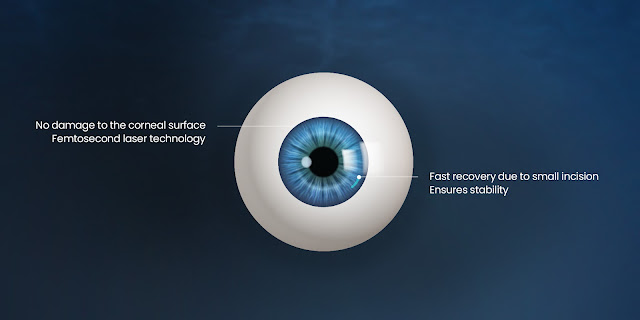
SMILE: A lens-shaped piece of tissue is created within the
cornea and removed through a small incision. Unlike the other two procedures,
SMILE does not involve creating a corneal flap or removing the surface
epithelium.
Is there a definite ranking of which procedure allows the fastest recovery?
There is not yet
sufficient primary evidence to establish a definitive numerical ranking of
recovery times. The Cochrane review identified four trials involving 392
participants and 538 eyes comparing LASEK with LASIK, but only three trials
involving 154 participants provided data that could be used in the analysis
[1].
None of those three
trials reported postoperative pain scores [1]. They also did not report visual
loss or quality of life at 12 months [1].
In other words, some
of the outcomes patients care about the most are missing from the comparative
evidence.
So, what has been established?
The available
evidence suggests that visual outcomes at 12 months do not differ significantly
between the procedures. The risk ratio for achieving uncorrected visual acuity
of 20/20 or better was 0.96 for LASEK compared with LASIK [1].
In the same
comparison, the risk ratio for achieving uncorrected visual acuity of 20/40 or
better was 0.90 [1]. For both figures, the confidence interval crossed 1,
meaning the results did not establish a statistically significant difference
between the procedures [1].
A review comparing
LASEK with photorefractive keratectomy (PRK) found a similar result. Across 11
trials involving 428 participants, the risk ratio for achieving uncorrected
visual acuity of 20/20 or better at 12 months was 0.98 [2].
How did SMILE LASIK differ from conventional LASIK?
The differences
between SMILE and LASIK were observed in tear-related symptoms and corneal
sensation rather than visual acuity. A meta-analysis comparing the two
procedures found no significant differences in any of the visual outcomes
assessed within six months after surgery [3].
Dry-eye symptoms, however,
differed. At six months, dry-eye symptom scores were higher in the LASIK group
[3].
Corneal sensation
also differed. At six months, corneal sensitivity—the cornea's ability to
perceive stimulation—was lower in the LASIK group [3].
|
Outcome |
Findings at 6 months |
|
Uncorrected visual acuity of 20/20 or better |
No significant difference between the procedures [3] |
|
Loss of one or more lines of best-corrected visual acuity |
No significant difference between the procedures [3] |
|
Achieving a refractive outcome within ±1.0 diopter (D) of the target |
No significant difference between the procedures [3] |
|
Dry-eye symptom scores |
Higher in the LASIK group [3] |
|
Corneal sensitivity |
Lower in the LASIK group [3] |
The authors rated the quality of evidence in this meta-analysis as low to very low [3].
Does the difference in dry-eye symptoms persist?
The difference in
corneal sensitivity had narrowed by around six months. A meta-analysis of five
studies involving 245 participants and 363 eyes found that central corneal sensitivity
was similar between the two groups before surgery [4].
At one week, one
month, and three months after surgery, corneal sensitivity was lower in the
LASIK group [4]. By six months, the two groups had similar levels of
sensitivity [4].
The authors cautioned
that the findings should be interpreted carefully because the number of
included studies was small [4].
Do better laser systems produce better results?
There is no clear
evidence that differences in laser technology lead to significantly different
visual outcomes. A Cochrane review analyzed 33 randomized trials involving
1,499 participants and 2,797 eyes, comparing wavefront-guided refractive
surgery with conventional approaches [6].
The risk ratio for
achieving uncorrected visual acuity of 20/20 or better was 1.03 [6]. No
significant differences were found in the proportion of patients maintaining
their best-corrected visual acuity or achieving a refractive outcome within
±0.5 D of the target [6].
The findings were
also similar when optimized and guided wavefront approaches were compared. At
12 months, the risk ratio for achieving uncorrected visual acuity of 20/20 or
better was 1.00 [6].
What should you consider when choosing a procedure?
The deciding factor
should not be the procedure's name, but the characteristics of your individual
eyes. Because the available evidence does not establish clear overall
superiority of one procedure over another, factors such as corneal thickness,
refractive error, and tear-film condition become important in determining which
options are suitable for you.
Some outcomes were
reported specifically in the LASEK-versus-LASIK comparison. The proportion of
patients achieving a refractive outcome within ±0.5 D of the target was lower
in the LASEK group than in the LASIK group [1]. In one trial, refractive
regression was reported in 8 of 37 eyes in the LASEK group, compared with none
of the 39 eyes in the LASIK group [1].
Corneal haze was
uncommon. At six months, mild haze was observed in 1 of 76 eyes in the LASEK
group and in none of the eyes in the LASIK group [1].
The quality of
evidence for all these findings was rated as very low or low [1].
What should you ask
during your consultation?
During
your consultation, focus on your individual measurements and how they affect
your eligibility for each procedure.
1. Corneal thickness: What is my corneal
thickness, and does it allow me to undergo a procedure that reshapes the
cornea?
2. Refractive error: How much corneal
tissue would need to be removed to achieve my intended correction?
3. Tear-film condition: What do my
preoperative tear-film tests show? Do I already have dry-eye symptoms?
4. Procedure recommendations: If you recommend a
different procedure, which specific measurements or findings are driving that
recommendation?
5. Next steps: If the intended refractive outcome is
not achieved, what options would be available afterward?
6.
The prevalence of myopia provides
useful background. According to the KDCA, myopia affects approximately 70–90%
of the total population in some Asian countries, 30–40% in Europe and the
United States, and 10–20% in Africa [5].
7.
There are also options that do not
involve removing corneal tissue. Procedures that implant a lens inside the eye
are discussed in articles about intraocular lens implantation.
8.
To determine which procedure is
suitable for your eyes, consult an ophthalmologist and undergo a comprehensive
examination that includes corneal thickness measurements, refractive
assessment, and tear-film testing.
Sources
- Kuryan J, Cheema A, Chuck RS. Laser-assisted subepithelial keratectomy (LASEK) versus laser-assisted in-situ keratomileusis (LASIK) for correcting myopia. Cochrane Database of Systematic Reviews 2017;2:CD011080
- Li SM 외. Laser-assisted subepithelial keratectomy (LASEK) versus photorefractive keratectomy (PRK) for correction of myopia. Cochrane Database of Systematic Reviews 2016;2:CD009799
- Shen Z 외. Small Incision Lenticule Extraction (SMILE) versus Femtosecond Laser-Assisted In Situ Keratomileusis (FS-LASIK) for Myopia: A Systematic Review and Meta-Analysis. PLoS One 2016;11(7):e0158176
- He M, Huang W, Zhong X. Central corneal sensitivity after small incision lenticule extraction versus femtosecond laser-assisted LASIK for myopia: a meta-analysis of comparative studies. BMC Ophthalmology 2015;15:141
- Korea Disease Control and Prevention Agency (KDCA), National Health Information Portal. Refractive Errors (Myopia, Hyperopia, and Astigmatism).
- Li SM 외. Wavefront excimer laser refractive surgery for adults with refractive errors. Cochrane Database of Systematic Reviews 2020;12:CD012687
This article provides general information
based on Cochrane systematic reviews, peer-reviewed scientific literature, and
publicly available information from the Korea Disease Control and Prevention
Agency. It does not recommend any specific surgical procedure or laser system.
The procedures suitable for your eyes should be determined through a
comprehensive eye examination and consultation with an ophthalmologist.

Comments
Post a Comment